
Today, I’m bringing you words from Lee Glandorf, the writer behind The Sweat Lookbook. Last year, I shared the story of Flo Jo and other Black women running icons on the podcast, and I thought it would be great to share how she’s still inspiring sports fashion. This is a long read, but it gives such a vulnerable look into the making of a performance streetwear brand. It’s a great way to kick off Black History Month. I hope you enjoy!

I’ve been eager to sit down with PYNR’s founder Sid Baptista for a long time. While my mission with The Sweat Lookbook is to explore performance through the lens of the female athlete, I’m also fascinated by the way that sports, culture, and fashion overlap. Sid’s work building PYNRS – a streetwear-inspired performance running brand – sits squarely at that intersection. Plus, Sid and I share some deep Boston roots and a desire to show that the city is more than just Brahmins and Southie.
In previous newsletters that have examined running’s new boom, I’ve lamented the fact that few trend pieces acknowledge that sport has become cool thanks to years of tireless work by run crew leaders of color who built a more inclusive culture on which today’s new clubs and brands are modeled. Indeed, the very concept of “coolness” is deeply rooted in Black traditions. Trend strategist Anu Lingala of WHAT’S ANU broke it down in a must-read post just last week:
The origins of its modern meaning “trace back to West African traditions, where concepts like ‘itutu’ (Yoruba for ‘coolness’) symbolized spiritual composure, grace under pressure, and quiet strength.” This concept was later leveraged by African Americans, who used coolness “as a coded survival mechanism — a way to maintain dignity, expression, and inner sovereignty under oppressive conditions.
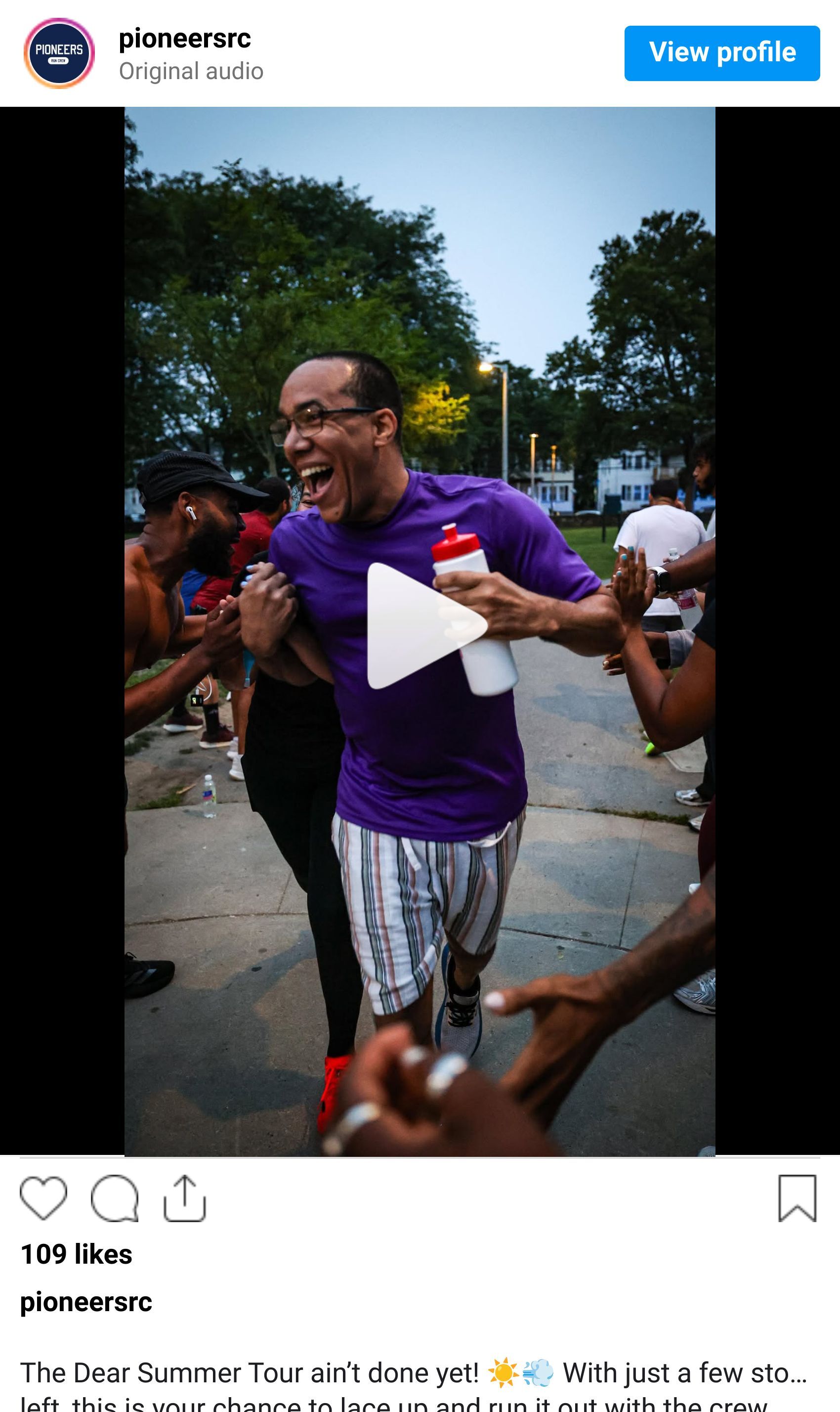
Sid got his start as a run leader more than a decade ago, founding Dorchester-based Pioneers during the third wave of run crews born from the blueprint of NYC’s Bridge Runners and London’s Run Dem Crew. After four years of building the crew, he recognized a void in the marketplace for running apparel that centered his community both in terms of aesthetics and fit. Thus, PYNRS was born.
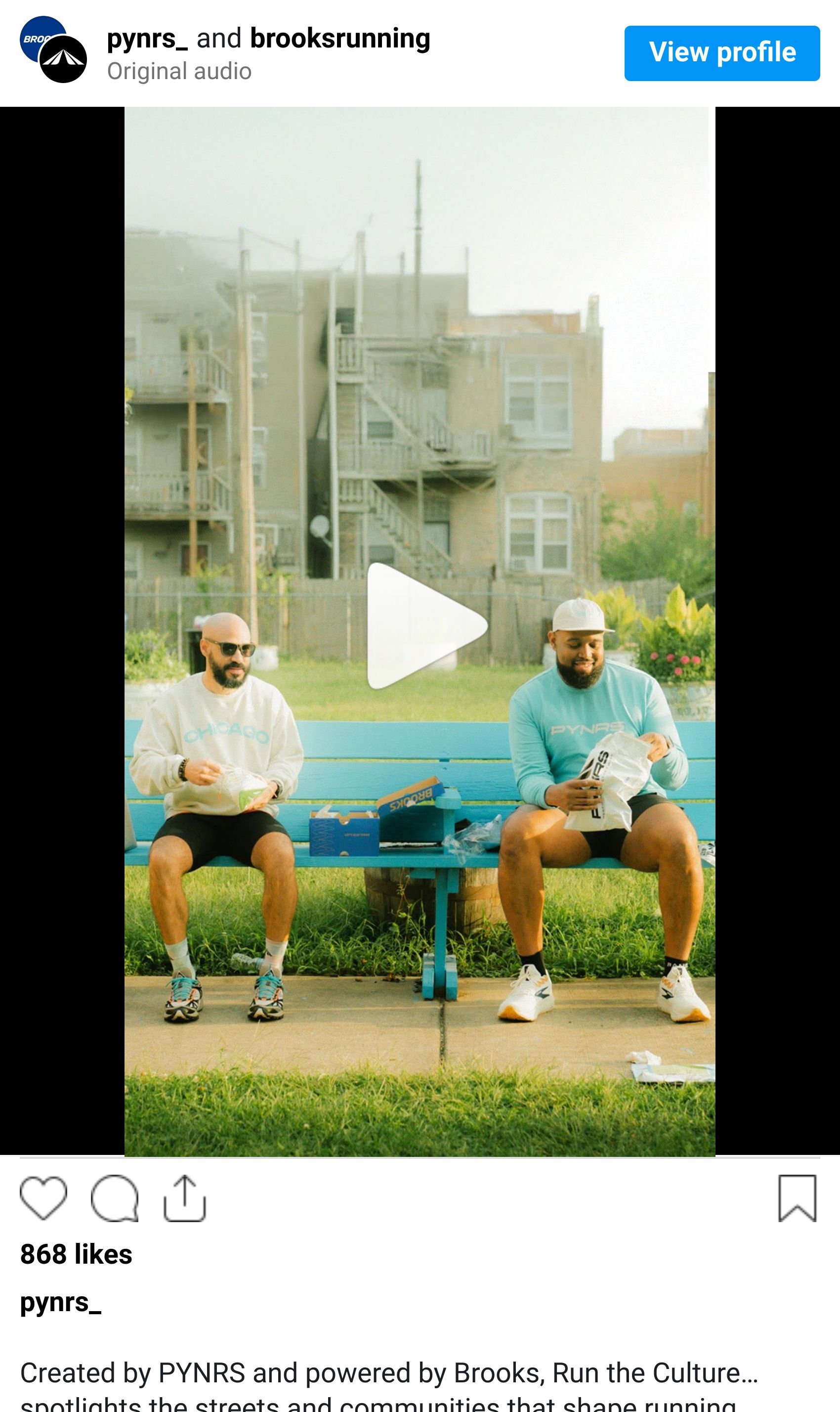
At a time when there’s a sea of bros sameness in the running industry, PYNRS stands alone as the only Black-owned performance running apparel brand. This fall marked a major moment for the business, with a Brooks collaboration and a new apparel collection inspired by Flo Jo and Michael Johnson. The content for the collaboration is some of my favorite storytelling from a brand I’ve seen this season, an “unabashedly Black” IFYKYK campaign that amplifies “the voices of diverse runners and local crews who’ve shaped running culture for years but aren’t always seen on the global stage.” Check it out.
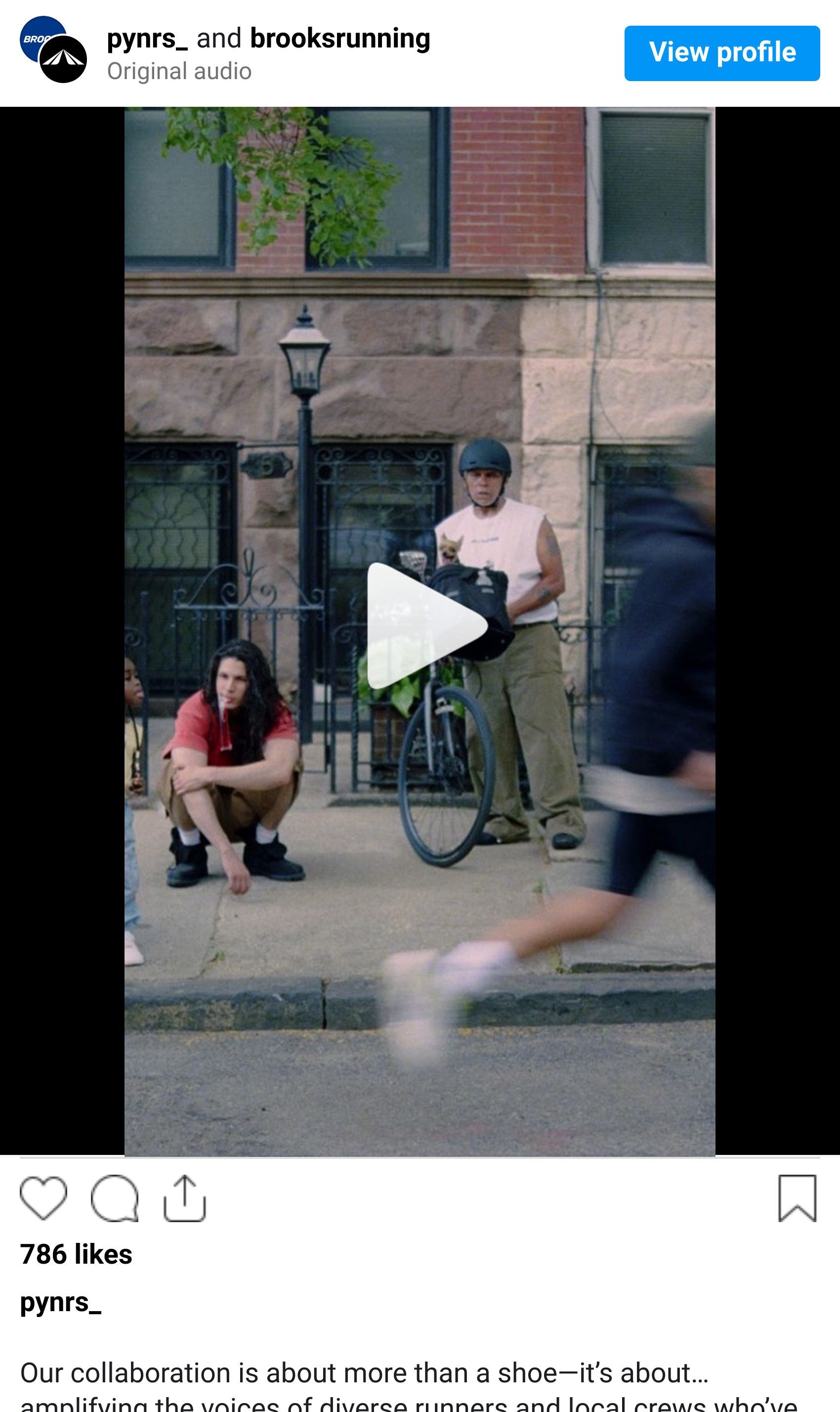
I hopped in to help Sid with some PR outreach for the launch, and was honestly disheartened by the lack of interest from the big running aggregator accounts on Instagram, who proudly claim to “cultivate running culture” by shilling the latest Oakley x Satisfy release or a Swarovski bejeweled Nike Vomero, and yet were noticeably silent on this launch.
Sid was optimistic, if sanguine.
Some people get it right away; some people need time,” he says. “But that’s okay. We’re pushing it forward.
In conversation with Sid Baptista, PYNRS.
Lee: Let’s start at the beginning: how did you get started in sports? And do you remember what you wore?
Sid: Oh man — depends what you mean by “sports.” Team sports? I grew up in the city, running around. I was born in the ’80s, grew up in the ’90s, playing every sport — basketball, stickball, football, soccer. All of it on concrete.
We even played roller hockey, rollerblade hockey. Real ‘90s stuff — cars would come, we’d all move, then jump right back into the street.
I grew up in a family that owned sportswear stores in the ’90s. Back then, you could actually get accounts with brands like Nike or Fila. My uncle had a couple of those stores, and I remember wearing the hottest shoes straight from his shop.
I remember high-top Filas and the Penny Hardaways. It was more about sneakers than clothes — but yeah, definitely the sneakers.
Lee: How did you start running?
Sid: I was always fast as a kid — that’s what made me a decent soccer player. I wasn’t that skillful, but I could run. I’d just kick the ball and outrun people.
Lee: That’s the same story for a lot of us.
Sid: Yeah, but I’d miss layups in basketball and kick the ball over the net in soccer. Even in high school, I didn’t really get running until I joined the track team my junior year. By senior year, I broke all my high school records — 100, 200, 4x1, 4x4 — went to states, went to Penn Relays.
After high school, I didn’t run in college — I played basketball, hurt my knees, and kind of fell off running for a while. One day, I saw my boy Jarick [Walker]— he’s with The Speed Project now — running downtown with Nike Run Club. I was like, “Why are you so happy, bro?” And he said, “Come try it.” That’s how I got into running.
Lee: And then three or four years later, you started Pioneers Run Crew?
Sid: Kind of. I first co-founded a group called Unnamed Run Crew around 2015. Two years later, in 2017, I started Pioneers Run Crew. At that point, I understood more about crew culture and what I wanted to build.

Lee: We’ve been working on a project about the history of run crew culture, and it feels like there was this mini boom of run crews that came out of Nike Run Club. Nike pulled funding from a lot of those groups, and people went out and started their own. And you had Bridge Runners and Run Dem Crew, which were separate but still orbiting that Nike ecosystem, right?
Sid: Exactly. You’ve got the OGs — Bridge Runners and Run Dem Crew — who were around before 2010. Then you have that post-2010 wave: We Run Uptown in New York, 3Run2 in Chicago, and a few others that started around 2011–2013.
Then there’s the next generation — the 2015 to 2017 crews — and those are the ones that really grew out of Nike’s pullback. Pioneers came from that third wave.
Lee: Someone once asked me on a podcast to define the difference between a run crew and a run club. I had my take, but you’re the better person to answer that.
Sid: I’d say the biggest difference is that we don’t lead with running — we lead with culture and community.
Running is something we do, but it’s not the reason we exist.
A run club is usually about running faster, hitting personal bests, improving performance. A run crew is about belonging. People come to us not because they already love running, but because they see themselves in us — the people, the vibe, the energy.
That’s why crew culture resonates with folks who might’ve never thought of themselves as runners. When you start adding performance elements to a crew, the line blurs — but at its core, it’s culture first.
Lee: From my perspective, “crew” also feels more aligned with groups started by women or people of color — people who were intentional about creating space for those who didn’t see themselves in running.
Sid: Exactly. If you’re creating for people on the margins, you’re really creating for everyone. That intentionality matters.
Lee: Pioneers is based in Dorchester — Boston’s biggest and most diverse neighborhood — but usually the least represented outside of a few movies that use it as shorthand for “gritty Boston.” Why is this neighborhood so important to the story?
Sid: Right. I was born and raised in Dorchester and still live here. That’s where Pioneers Run Crew started — because this is home.
When I first got into running, I’d go downtown to run with Nike Run Club or Unnamed Run Crew. We were always meeting in the South End or Back Bay. It just didn’t feel like home. I wanted to bring running to my neighborhood, to make it accessible for people who lived here.
Dorchester’s a real mix — my block is mostly Vietnamese, a few streets over it’s Cape Verdean and Dominican. There’s culture everywhere. I wanted running to be part of that.
Lee: Where on the journey with Pioneers Run Crew did the idea for creating a brand take shape?
Sid: Honestly, it started with frustration. We did a campaign for Puma — they asked us to show up, bring the vibe, show how we run, and connect. We spent long days shooting, giving them that authentic energy — but everyone on set was getting paid except us.
The director, the stylists, the makeup artists, all white — all getting checks. Meanwhile, we were “the talent,” giving them culture for free. I remember thinking, They’re going to use this to sell product back to us, and we’ll never see a dime. It felt like the same pattern you see in music — the art gets taken and monetized by someone else.
That’s when I realized we needed to own some of the influence we were creating. It wasn’t, “Let’s start an apparel company.” It was, “Let’s build something we can own.”
Lee: And you were also seeing that the products on the market weren’t really made for your community, right?
Sid: Definitely. People were remixing their gear — trying to look good, but also just trying to make stuff fit.
I remember reading a GQ piece about the “best running shorts,” buying a pair, and they didn’t fit my thighs. I’m a lean runner, but I’ve got muscle — West African genes, you know?
Then we did a partnership with Lululemon — they sent us product, and we were grateful, but none of it fit our women. It was disheartening. The people at the brand had good intentions, but the product just wasn’t made for bodies like ours. That’s when I thought, Okay, we need to create something ourselves.
And when you look at brands like NoBull and Tracksmith — both started here in Boston and thriving — it made me think, “Why not us?” You’ve got to be a little naïve to try, but that’s how it started.

Lee: Can you give me a little context on the name — why PYNRS?
Sid: When I started thinking about launching a new crew, I didn’t want another “Unnamed” situation where we just threw something up on Instagram and figured it out later. I wanted something meaningful.
I knew the community I wanted to build would be diverse — people of color, sure, but also anyone from the neighborhood who wanted to move with us. Around that time, I learned about the New York Pioneer Club, one of the first large-scale integrated sports clubs in North America, started in Harlem in the 1930s by three Black men — Joseph Yancey and two others.
They were pioneers in every sense — they integrated sports before the NFL, NBA, or MLB did. One of their members, Ted Corbitt, went on to become the godfather of modern distance running: first president of New York Road Runners, helped invent the way marathons are measured, literally mapped out the New York City Marathon course.
So I wanted to pay homage to that lineage — to remind people that Black runners have always been here. When folks say “Black people don’t run,” I can point to that history and say, “Actually, we invented half of this.” PYNRS is short for Pioneers — and it’s a way of grounding ourselves in that legacy while also saying, we’re all pioneers in our own right.
Lee: One thing that stands out about PYNRS is that you live your values through the design process — especially when it comes to fit. How do you approach building apparel?
Sid: Everything we do starts with centering the experience of Black and Brown runners. That means beginning with fit models who actually reflect our community — athletic builds, strength in the legs and hips, not just tall and skinny.
We build from there instead of designing for the “standard” fit and then trying to retrofit diversity later. We’re not saying, “Oh, let’s make this product and then market it to this group.” We’re starting with that group in mind from day one.
From a design standpoint, we usually start with fashion rather than performance. The Flex collection this year was an exception — that one started from running, but even that was inspired by Flo Jo. And Flo Jo herself pulled from fashion — the nails, the jewelry, the styling.

Lee: For Fall, the Flo Jo inspiration really shows — the necklines, the modular pieces.
Sid: Yeah — we looked at how she layered shrugs and leg sleeves, how she accessorized. From that, the women’s Flex Kit has a hooded shrug and leg sleeves. On the men’s side, we looked at Michael Johnson — he used to wear a deep-cut singlet — so we re-imagined that.
We added a men’s shrug, which is functional: you can wear it for warmth early in a race, then take it off and loop it behind you instead of tossing it. It’s different, but practical.
Lee: I saw Jaylen Brown (a PYNRS investor via his Boston Xchange platform) wearing the tracksuit at your event.
Sid: Yeah! He showed up decked out in his Oakley collab and was like, “I need some of that.” Tried on the Brooks shoes, loved them — said it was his first time in Brooks.
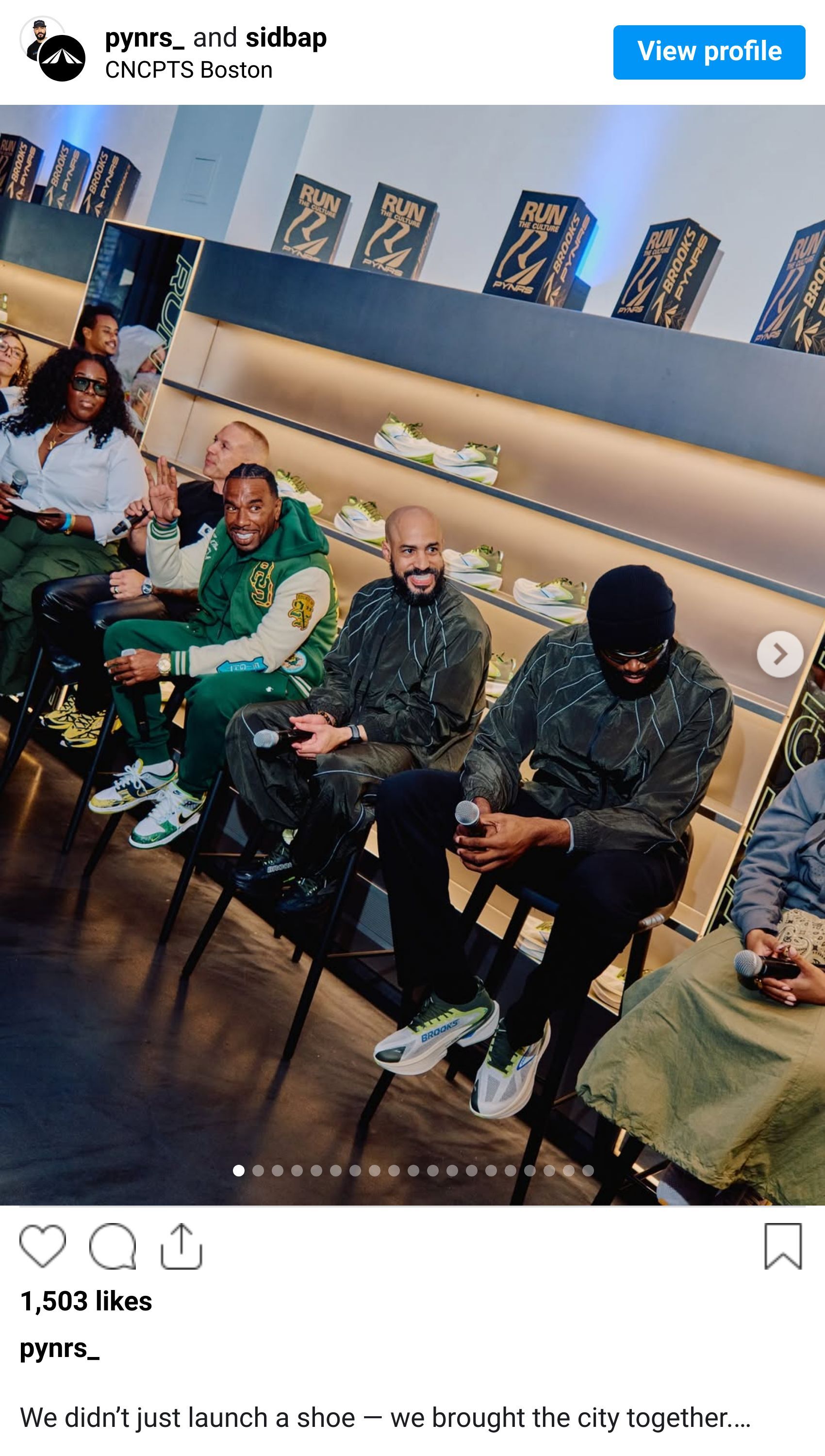
Lee: Let’s talk about the Brooks collaboration. It’s the first time you’ve done a footwear partnership, right?
Sid: Yeah. I was down at TRE 2023, going booth to booth like, “Yo, I want to do a shoe collab.” I talked to Puma, Saucony, and Brooks. Brooks already knew us — they’d supported our work that year and were the only major brand to publicly speak out after what happened at Mile 21.
I met Mike Peck, their VP of Creative, at TRE. He loved our visuals — asked who shot them — and connected me with Stevie Jones, who was building out Brooks’ lifestyle category. They saw PYNRS as the perfect partner.
They gave us the Hyperion Max 3 — a performance trainer that looks like a sports car. We ran with that.

Lee: What did you want to bring into the design?
Sid: I pulled in my guy Drew White — he designed the Kids of Immigrants × Nike kit that just won “Collab of the Year.” We brought in hi-vis green because we run in the city and need visibility, plus that military olive for our working-class roots. The speckled midsole nods to the cement Jordan 3s — my favorite pair ever.
Across the heel, it says Run the Culture. The PYNRS logo’s on the tongue, and the footbeds line up to form our mark — the road icon.
Lee: What’s the meaning behind that icon?
Sid: The road represents the streets we run — people coming from different paths but moving in the same direction. You don’t always know exactly where you’re headed, but you’re going together. That’s what PYNRS is about.
Lee: I recently wrote an article for Runner looking at women-led running brands. Maybe 20 percent of new, emerging brands are led by women — and only a handful by women of color. You actually helped introduce me to some of them: WhitePaw Run Mitts, Conscious Gear.
But a big theme in that piece was how hard fundraising is for underrepresented founders. I know you’ve been creative about how you’ve raised money. Can you talk about that?
Sid: Yeah — it’s been tough. Like, really tough. As people of color, we’re used to creating something out of nothing, so we get resourceful.
I’ve used every tool I could. We started with a Kickstarter. Then I got my first angel investor through someone I knew from a nonprofit board at a local inner-city school.
After that, we ran an equity crowdfund, inviting our community to literally own a piece of the company. We also experimented with blockchain-based revenue sharing — if the company made a certain amount, a percentage went back to the community.
We’ve had a few more angels come on since then, but the reality is: we’re bootstrapping every day.
Like, last night, we had this huge event — people saw the photos and thought, “Wow, this company is killing it.” Meanwhile, I was trying to check someone into a hotel, and all my corporate cards were declining. I had to put it on my personal card to make it happen.
We’ll get reimbursed, we’ll make money from the event — but that’s the grind. We’re always right on the edge, putting everything we have back into the business.
The Brooks deal helped a ton — it came with some upfront money, and I reinvested all of it to bring on Elizabeth McGarry of Daughters & Sons to help with the next collection. It gave us enough breathing room to build the Fall ’25 line. But honestly? We’re back to scraping again now that it’s done.
Lee: I think that transparency is so important. Most emerging brands in running are private — you rarely see how the sausage gets made. And yet, we talk about “voting with your dollars.” Understanding where the money comes from and who it supports matters.
Sid: Exactly.
Lee: I also think there’s this myth that brands create running culture. When I was at Tracksmith, we were always careful to say we were celebrating or supporting it — not creating it. Culture comes from the community. A brand can only amplify it.
And right now, with all these big activations — Nike, On, whoever — it feels like people are getting distracted by the glitz and forgetting what running culture really is.
So I want to ask you: in this post-2020 “running boom,” what are you seeing? What’s exciting you — and what’s frustrating you?
Sid: The boom has been amazing overall. It’s brought so many new people into the sport — people who never saw themselves as runners before. That’s good for all of us.
Pre-2020, there were only a few small lifestyle running brands — Tracksmith, Satisfy — and they were doing good work, but the mainstream didn’t pay attention. Now, everyone’s running, everyone’s looking for identity, and that gives smaller brands like ours space to thrive.
I’m excited about that. People are realizing they can find the brands that speak to them. I never wanted to change who I was to fit into running — I just wanted to bring my identity into it.
But there’s also a downside. I’m seeing established run crews in big cities, especially New York, start to lose opportunities — sponsorships, marathon perks — that are now going to influencers or new brands. So the same people who helped build the culture are being pushed aside.
That’s frustrating. But here in Boston, we’re trying to stay open — to bring everyone in. There’s a lot popping up, and it’s exciting.
Lee: One thing that’s been bugging me is how often media stories about “the future of running fashion” or “hip-hop meets running” skip the actual run crews who built that bridge.
The coverage tends to start at the surface — like, “Look, hip-hop stars are leading runs now!” — without tracing it back to the grassroots movement that made running cooler and more inclusive in the first place.
Sid: I totally agree. It’s the same thing that happens in music — or on TikTok — where Black creators start something, and it gets co-opted once it goes mainstream.
That’s why ownership is so important. We’re not just creating a brand; we’re building an ecosystem. We build the community, the culture, the events people run at, the product they wear, the content they watch, the experiences they love.
There’s no reason we shouldn’t own all of that. We already have the blueprint. In Boston, we’ve got 26.2 True. In D.C., District Running Collective. In L.A., Through the West Side with Love and the Crenshaw Mile. These are experiences built by us, for us.
We can coach runners, host races, design gear, and create the spaces people want to be in — all within the same community.
Don’t let what happened in music, or on Twitter, or on Instagram happen again. Black culture built those platforms. We just didn’t own them.
So I see running as a new opportunity to do it differently — to keep some ownership as we grow.
We were just in London at the Represent store opening, and they hosted a run to launch it. Then last night at Concepts, they said it was one of the best events they’ve ever had — and it was a running event at a streetwear store.
That’s where culture is going. You don’t get there without run crew culture paving the way. I see that as a huge opportunity: to own our story while it’s being written.
Lee: I want to end on something I’ve noticed lately — your more competitive side coming out. You’ve been chasing new goals in the marathon. How did that shift happen?
Sid: When I first got into running, I wasn’t competitive at all. I didn’t know much about the sport — I’d sprint everything, burn out, then think, this is hard. I didn’t train seriously; I just liked bringing people in.
I ran my first marathon in 2015 — Chicago — totally undertrained. It was brutal, but it lit something up in me. Still, I wasn’t thinking about performance back then. I was thinking about community — how can I bring more people into running?
But over time, I started hearing comments — people saying things like, “Oh, PYNRS isn’t a real running brand,” or “That’s just streetwear.” I’ll be honest: that got under my skin. I wanted to prove we could do both — culture and performance.
So I started training harder. And as I did, I gained a new respect for runners who focus on performance. I remember seeing my friend Marv in L.A. earlier this year — he’s deep in the performance lane. I used to side-eye that, like, “Why make running exclusive again?”
But when I started chasing times myself, I understood. Just like you need community when you’re new to running, you need community when you’re pushing yourself, too.
Performance running deserves that same cultural grounding.
I even apologized to Marv — told him I used to think differently, but now I get it.
Lee: What’s your current goal?
Sid: I’m chasing sub-3 in the marathon. I went hard for New York, then London, but this summer was rough — I didn’t get the rest I needed. Between shooting Run the Culture and traveling city to city, I never really stopped. Normally it’s spring marathon, summer off, fall marathon — but this year I just kept going.
I’ve got a few half marathons lined up. I’d love to hit sub-1:30 at the New York City Half, maybe even flirt with 1:20 someday.
Lee: That’s ambitious — but I totally get it. What you said about wanting respect for the brand reminds me of what I heard from women founders, too. There’s this feeling that to be taken seriously, your brand has to prove its performance.
Especially now, when there’s this very specific “performance look” online — the Oakleys, the half-tights, the singlet. If you don’t fit that aesthetic, people question if your gear works.
Sid: Exactly. That’s real.
Lee: But that’s also why I’m excited about the future — because we’re starting to see more niches, more spaces where people can find their version of what running looks and feels like. The tent is getting bigger.
Sid: I hear you. And I think that’s exactly what we’re doing. Our Fall ’25 capsule, our photography — it’s already catching attention. A trend reporter from WGSN reached out about featuring our imagery. That tells me we’re moving in the right direction.
We know our people make things cool. We’re confident in that.
Lee: The content looks different, too. That Brooks campaign you put out — it feels new. Directional, but still true to you.
Sid: Yeah — thank you. We wanted it to look like us.
It’s a different perspective. I think we’re showing what running culture can be — layered, joyful, rooted in community.
💌 Thank you for reading!

Lee Glandorf is a runner and marketer writing about women’s sports and fashion. If you enjoyed the article, check out her newsletter and share this with someone who would enjoy it!
If you’d like to sponsor editions of Melanin MVP and reach {{active_subscriber_count}} everyday athletes and sports industry professionals, you can respond to this email.